
Literary Analysis
A close reading of the first page of N.K. Jemisin's THE FIFTH SEASON

First and foremost, if you aren’t following Emily Charlotte on Instagram or TikTok, stop what you’re doing and go do that now. A while back, she started Marginalia Monday on Instagram in which she annotated the first page of a novel on Mondays and shared her thoughts while also encouraging literary discussion. She’s also kickstarting a literary analysis series on TikTok which is guaranteed to be phenomenal. She’s a fabulous educator, writer, and human. Run, don’t walk.
Are you back from following her and consuming all her content? Good because here’s my first thought about literary analysis: perspective is key. The more perspectives you consume about any given piece of media or art will help you better understand the work as well as develop your own understanding of it. A rule of thumb I’ve taken away from literary analysis is if twenty people read the same article, you’ll hear twenty different opinions about it. Valid. But how do you start drawing your own conclusions?
Where to Start with Literary Analysis
As a high school teacher, I begin literary analysis with short pieces of fiction, and the first thing I ask them is: what do you notice? First, there’s glazed over expressions followed by half-shrugs and mumbled nothings, but I wait… and wait… and eventually someone will start with things that surprised or shocked them.
Like with my students, I’ll use “The Flowers” by Alice Walker as an example. It’s a super short story (1 pg), so go ahead and give it a read. Trigger warning: It’s heavy on racism once we really dig into it.
Student A: Did she step on a skull?
Me: What makes you think that?
Student A: She says that she saw his “naked grin.”
Student B: Yeah! And then she starts describing his body.
Me: What descriptions do you see?
Student C: He’s big, tall, and wore overalls.
Student A: But what about the noose?
And that question, dear reader, is what breaks this entire story wide open for analysis. I won’t lie to you, I tear up every single time we get to this revelation in the classroom, and the students do as well. But there’s also a spark, because this moment, this observation makes them lean back into the story for more.
That is where you begin with literary analysis. What makes you curious? Confused? Angry? Sad? Why does a line make you feel a certain way? I have my students write these questions and reactions on the page in the margins and between lines because it’s their own personal curiosities that will lead them to the most fruitful lessons a text can teach.
If you’re curious, ask questions. Much of “The Flowers” is revealed after reading it critically and closely, but even more is revealed with you research the author. Why is she writing about a little girl stepping on a skeleton in the woods? Why is the little girl named Myop? It’s a strange name. Until you look up myopia, and you realize that it’s a condition in which people can see close things clearly, but the farther things get, the blurrier they are. Okay, now we ask why? Why name the character Myop? What is she myopic about? Clearly, there’s a narrative of racism here with the noose and the skeleton. What can’t Myop see about the past?
And that’s for you to discover and back up through analysis.
But begin with questioning and observing everything.
I’ve included some resources below for further journeys into literary analysis. For now… My own take.
N.K. Jemisin’s The Fifth Season
If you’re friends of Turning to Story (the writing craft podcast I co-host), then you know how much I love The Fifth Season and everything N.K. Jemisin. Everything she writes is absolutely magic, and even after analyzing her work, I truly have no idea how she packs so much into a single sentence. Without even realizing it, she gets me to laugh and cry so damn easily.
Which is where my analysis starts.
I am a writer with a YA fantasy romance debuting Spring 2026. If I had pre-order links or a Goodreads page, I’d shamelessly plug them here. Alas, not yet. But I tell you this because it frames how I attack analysis these days. For me, my questions come from a writing craft perspective. How does Jemisin set up her novel on the first page to reflect the rest of the journey to come? How does she get me to laugh and cry all within these first few paragraphs? Also, how does she get me to turn the page?
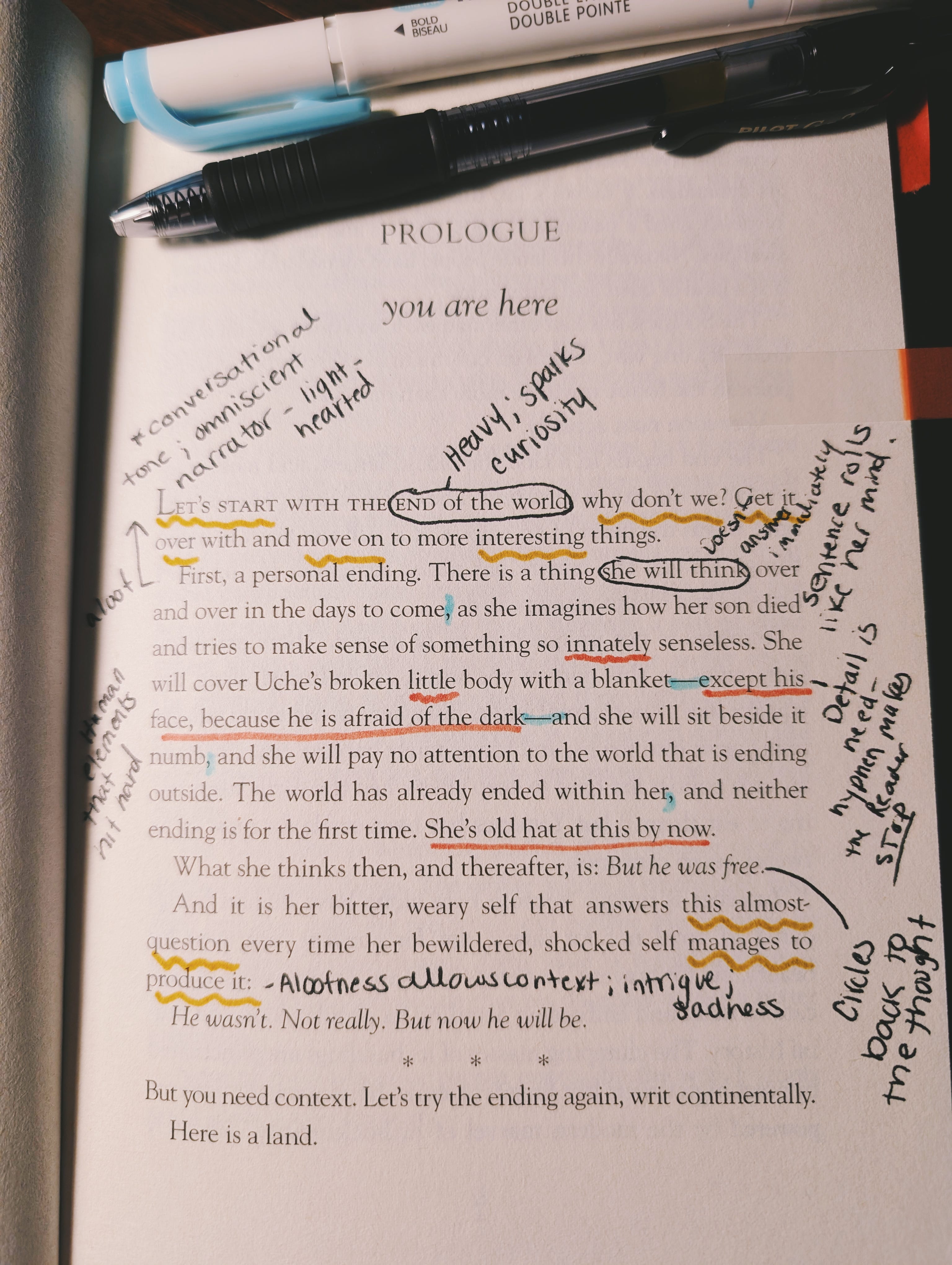
I want to address a few things in the image before I begin my summative thoughts of this page:
Do you need colorful highlighters? No. Do they help? Yes. Do I have a system for mine? Vaguely. It’s your analysis, so you get to make up the rules for your brain.
A basic key for my colors
Yellow= the aloof third person narrator
Red= gut punch emotion
Blue= curious punctuation
You wrote in a book?! Yes. Yes I did. It’s mine, gifted to me by my fabulous mother-in-law, and I believe books you love are meant to be DEVOURED. By scrawling in the margins, you claim this book to be part of your very soul. I hope one day someone does the same with my work—hopefully out of love rather than tearing it apart, but hey… engagement is engagement.
Is there a right way to do this? Hell no! And there isn’t a wrong way either. You find what you want to find.
TRIGGER WARNINGS FOR THE PASSAGE: It deals with the ending of the world and the death of a young son.
My Observations
The Fifth Season opens in a very uncharacteristic way with an omniscicient, sassy narrator. They’re conversational in tone, especially about something that should be so tragic (the end of the world). Why? To set a tone that this book, while dark at times, will be funny. Jemisin promises that you will laugh, and she will take care of you even when the character’s lives are bleak. And they get bleak. But the end of the world? No big deal. As we learn later in this section, it’s happened before. It’ll happen again. Whatever. That’s not the point.
So what is the point?
That’s where the human connection comes into play. The second paragraph starts with what all good books (or at least books that I love) contain: a personal story. While this story is framed around the ending of the world, it’s really about the people we’ll meet along the way, beginning with the mother of Uche.
If we follow my student example from above, the first thing I noticed in this section was the line, “She’s old hat at this by now.” Oof. What a gut punch of a line. This is where analysis comes in. WHY does that line hurt so damn badly? Well, it tells me that this (suffering and the literal end of the world) has happened to her not once or twice, but numerous times. The line is an attempt to brush away the sadness, which makes it even more heart-wrenching because we know she cares. Okay, HOW do we know? She spends days trying to understand how something so “innately senseless” could happen. She describes his “broken little body” and ensures she doesn’t cover his face because he’s afraid of the dark.
I’m grabbing a box of tissues as I type this even though I’ve read it a hundred times.
Jemisin grounds the reader in this woman’s pain and struggle, and I understand her immediately. I don’t know her name, but I don’t need to. I need to know she’s doing her best to carry on, but she’s weary to the bone.
This is another promise Jemisin makes to the reader: This story will hurt. There might be magic, and the apocalypse will crush everything, but nothing will hurt you worse than the personal struggles the characters will face.
The next thing I noticed was the tone shift in the last few lines. It turns from sorrow to bitterness, and that’s directed at a question the mother tries to answer. Jemisin never tells us the question outright, but we can infer based on the mother’s thoughts. She believes her son is free, or at least tries to convince herself that he is. Instead, she answers this internal question that he isn’t. “Not really. But now he will be.”
Interesting. What in the hell does that mean? Well, there’s a reason Jemisin ends the section with that line. It sparks curiosity in the reader. What is the boy free of? Why does she sound relieved about this? You have to find out, so you read the next line. But the answer isn’t there yet. So you read the next line.
In turn, the next line returns to the aloof narrator with a touch of humor. “Here is the land,” the narrator says. Like, do you remember that viral comedy video “The End of the World” from the archaic days of YouTube? “Here is the Earth. Damn, that is a sweet Earth you might say.” It’s giving that video. You can’t help but laugh at the absurdity of having just read about a mother’s greatest loss only to be whipped around to a geography lesson.
Why? Because Jemisin promised she would make us laugh. That she would take care of us when times get rough, and boy did they get ROUGH super quickly.
A Level Deeper
Analysis can go down to the depths of studying specific punctuation. It can look at syntax and vocabulary. Sometimes, I’ll take it to that level because I’m deeply invested. Sometimes, I won’t.
For this section, I wanted to look at Jemisin’s sentence structure.
“First a personal ending.” Short and sweet. The narrator is aloof. It’s just a personal ending—no big deal—because you need to know it. No other reason.
“There is a thing she will think over and over in the days to come, as she imagines how her son died and tries to make sense of something so innately senseless.” What a sentence. There’s a few clauses here looped together with some interesting word choices. The focus of the sentence is on the thought she has rather than the fact her son dies which is a clause shoved in after the comma. It’s almost an afterthought. Which makes sense when we get to the line about this being old hat for her. But we know it’s not an afterthought. She spends days trying to make sense of something that is “innately” nonsensical. The sentence only has one comma, but that comma allows our brain to keep going, spiraling much like the mother’s thoughts. She jumps from the reality of her son’s death to the why of the death. I’ve never experienced the loss of a child, but I know shock. Thoughts skitter together, stitched by words that tumble, causing a chain reaction of one memory connecting to another until it’s out of control. The comma here helps that happen. It creates that whiplash speed in which we too are in shock.
This chaotic rhythm continues in the following sentence in which she uses em dashes (—) and a comma to stitch together a ton of information. I won’t dive too deeply into that, but it’s fascinating to study why that long sentence comes before the phrase, “The world has already ended within her, and neither ending is for the first time. She’s old hat at this by now.” Oof, I say again. Oof. Do you see the sense of rhythm here? The spiraling horror of a mother who has lost her son only to end in a punch of reality? She’s been there, done that.
Conclusions
There are a thousand conclusions I could make about this opening. I could dive into her use of punctuation or her choice to open with an dispassionate omniscient narrator. The truth is, each time you read a work, you’ll learn something more about it.
For now, my takeaway is this: Jemisin uses perspective to make and deliver promises to the reader. By the end of this page, I know I’m in good hands with author because she’s proven that she will take care of me through the heavier topics, and that this story will be about so much more than the end of the world. By the end of this book, I will feel so deeply. Also, as a writer, I love that she promises me that she will make me ask questions, but she will also provide me the answers. In time. If I think.
Resources
I took a peek at this series, and I like her approach to analysis. She has different levels, which is awesome!
If you’re feeling particularly scholarly, check out this Short Guide to Close Reading, or search for any close reading guide. There are tons of resources out there for all types of analysis.
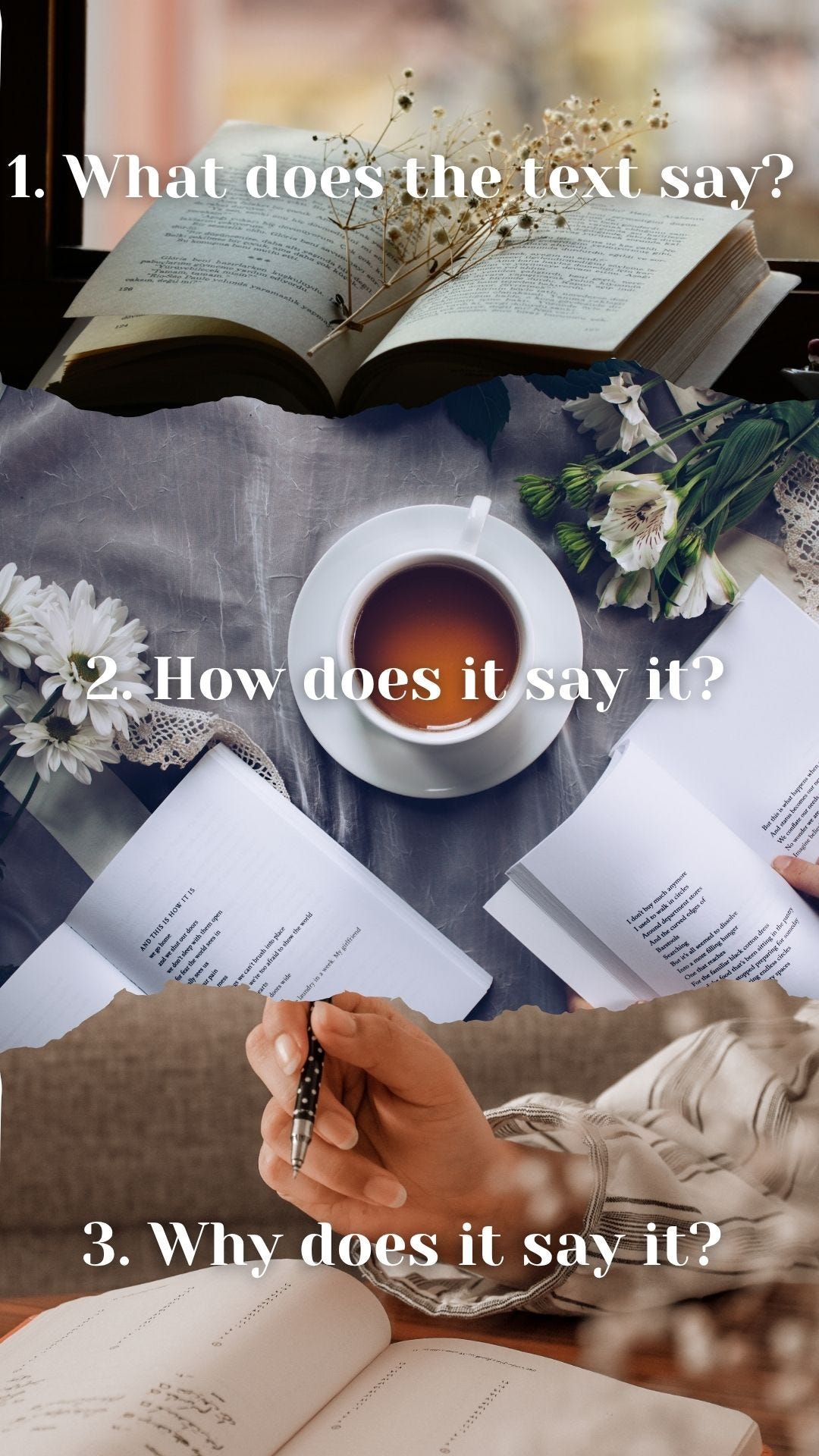
And here’s a handy little graphic I made (pls clap) to remind you of my basic steps.
Literary Analysis Moving Forward
My hope is to post an analysis twice a month at the very least, but if there’s interest in more, I’ll happy try once a week! Also, join in the discussion below. What are your thoughts or observations on the first page of Fifth Season? What’s a book or work you’d like me to analyze?
Let me know!
BRILLIANT. I'M GONNA COME BACK AND REREAD AND ADD MORE BUT JUST HAD TO SAY I'M SOOO HAPPY YOU'RE GIVING YOUR LIT ANALYSIS THOUGHTS!! (Also your shout-out is WAY too kind!) Cannot wait for as much of this as you're able to give!!!
Great analysis! Brings me back to good ol' high school English 🥲 As an em dash addict, I'd be interested in more examples of em dash use.